


R101 Airship of 1930 in 1:600 or 1:700 scale
R101 Airship of 1930 in 1:600 or 1:700 scale
3D Printed Kit
Couldn't load pickup availability
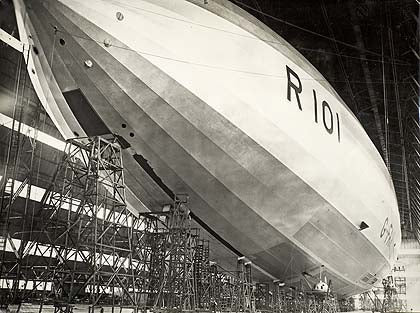
This model is of the British R101 Intercontinental airship as she was on her final voyage in 1930.
In 1:600 scale the model is 395.9 mm Long, 66.5 mm wide and (including the stand) 99.2 mm high
In 1:700 scale the model is 339.3 mm Long, 57.0 mm wide and (including the stand) 88.9 mm high
A download link to a comprehensive construction guide for this model appears at the end of these notes.
BRIEF HISTORY
His Majesty’s Airship R101 was arguably the most beautiful of the big intercontinental passenger airships of the inter-war period and sadly one of the most tragic. She was one of two designs chosen to launch the British Government's Imperial Airship Scheme, an ambitious plan to link the then enormous British Empire with a passenger and mail airliner service. R101 was built at the state owned Royal Airship Works in Cardington, Bedfordshire, England whilst the other ‘ship, the R100, was built by the privately funded Airship Guarantee Company (a subsidiary of Vickers), at Howden in Yorkshire. Since the government of the day was run by the Labour Party the public soon nicknamed the two as the “Capitalist Airship” and the “Socialist Airship” respectively. Perhaps inevitably, R101’s design and operation were impacted heavily by government interference from the outset, but a lot of superb workmanship went into her construction. Many innovative and interesting design features managed to survive the government-imposed controls but too little time was ever allowed for testing them out. Ironically her fate was sealed by official demands that very wide safety margins be built into all of her systems. This of course increased her weight and catastrophically reduced the most necessary margin of all for an airship - maximum useful lift. On completion in October 1929, the ‘ship was the largest man made object ever to fly and had superb passenger accommodation. R101 was conceived as a lavish floating hotel with wonderful luxuries, even when judged by today's standards. The open promenade decks and public spaces were unique in the skies. In fact the large British airships were the first to adopt the idea of constructing the passenger accommodation within the envelope. The only contemporary which was offering a passenger service was the German LZ127 - Graf Zeppelin, which accommodated just 20 passengers in a stretched forward gondola hung beneath the envelope. R101 boasted two decks of space including a dining room which could seat 60 people at a time and a smoking room which could seat 20. The promenade decks with their massive windows gave the passengers undreamt of views as they traversed the earth. Compared to the noisy, smelly and very tiring travel experience offered by contemporary aeroplanes, the airships delivered pure luxury, with service comparable to that of the greatest ocean liners. In October 1930, after just one sixteen-hour test flight following a major rebuild to increase her lift, the crew and controllers of R101 were urged on to make her maiden voyage to Karachi in that part of India which was to become modern Pakistan. The then Secretary of State for Air for the British government, Lord Thomson memo'd "I must insist on the programme for the Indian flight being adhered to, as I have made my plans accordingly." At 18h24 on 4 October 1930, R101 backed away from the mooring mast at Cardington and headed into a night of increasingly heavy rain and strong headwinds. Some observers thought that she was struggling to gain height even as she left Cardington field. Just after 2 am the following morning, R101 crashed into a hillside in Beauvais, northern France. There were only six people who survived, 48 crew and passengers died, and with them the hopes and dreams of the British "Imperial Airship Scheme".
Share


Looks to be accurate and the decals are neat. Assembly proved difficult as the central joining ring was very hard to fit into the forward part of the ship due to distortion of the hull at that point. Eventually I managed to fit the internal ring but it resulted in a poor fit and I could not align the matching longitudinals properly. Which is a pity as the rest of it is fine but resolving that joint is going to be a big issue.
Made-to-Order Manufacturing
At 3DPT, every model is manufactured to order rather than pulled from warehouse inventory. This approach allows us to offer an extensive catalog while ensuring each piece is produced with the care and attention it deserves.
Most orders ship within 7-14 business days. However, larger models, complex projects, and high-volume orders may require 4-6 weeks or longer due to extended print times and production requirements.
While extended lead times are uncommon, they may occasionally occur during periods of high demand or due to circumstances outside our control. We appreciate your understanding as we continue our mission of preserving transportation history in miniature through high-quality, made-to-order models.