
Soo Line/Wisconsin Central
Soo Line/Wisconsin Central
3D Printed Kit
Couldn't load pickup availability
General History:
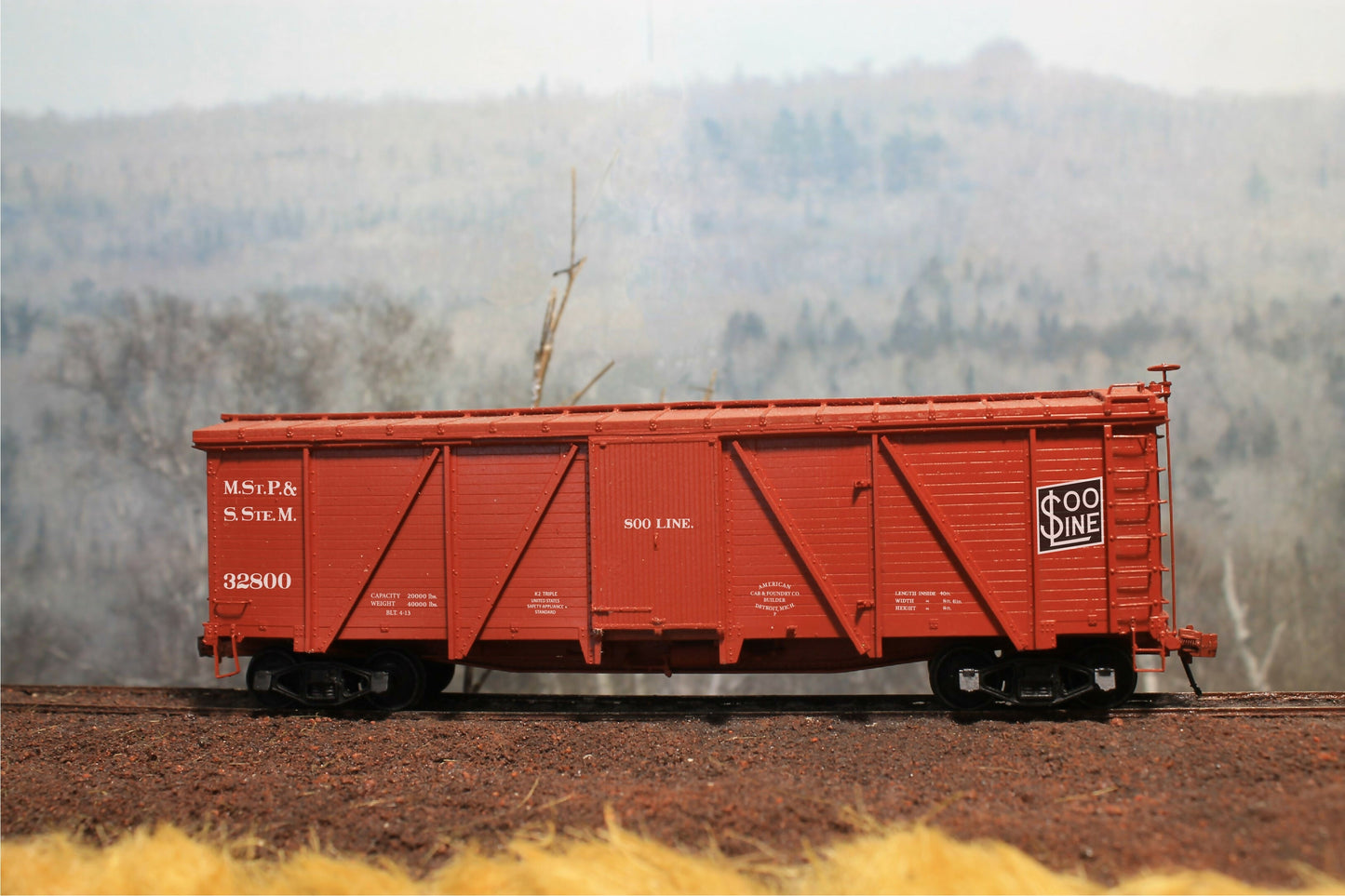
The famous “Fowler” boxcar of 1909, first installed on the Canadian Pacific railway, was one of the first successful single-sheathed boxcars in North America. The neighboring Minneapolis, Saint Paul and Sault Ste. Marie (“Soo Line”) railway was quick to follow this trend. A new car was developed using the basic Fowler design features. The length was to be 40 feet, and the side braces extended below the side sills to connect to the cross braces in what became nicknamed the “sawtooth” configuration. The first Sawtooth boxcars were built in 1913 by American Car and Foundry. Soo Line subsidiary Wisconsin Central received several batches as well, beginning in 1914. From 1913 until 1930, 5,400 Sawtooth boxcars were built, eventually making up almost 1% of the United States boxcar fleet. This kit represents the 1913, 1914 and 1915 deliveries of Sawtooths, with distinctive deep "fishbelly" center sills, which have never been commercially available.
Instructions:
Version List:
1913 Soo Line Delivery:
A: Original Lettering, 1913-1920
B: Updated Lettering, 1920-1930
C: Modern Lettering, 1930-1960
D: Modern Lettering, AB Brakes, 1930-1960
1914 Wisconsin Central Delivery:
E: Original Lettering, 1914-1920
F: Updated Lettering, 1920-1930
G: Modern Lettering, 1930-1960
H: Modern Lettering, AB Brakes, 1930-1960
1915 Soo Line Delivery:
I: Original Lettering, 1915-1920
J: Updated Lettering, 1920-1930
K: Modern Lettering, 1930-1960
L: Modern Lettering, AB Brakes, 1930-1960
Share
this is a great model all holes for grab irons were easy to find kit is very well detailed a first class project keep up the good work
This kit builds to a highly prototypical and satisfying model, including spotting features differentiated from similar later built SOO wood boxcars. With 3D printing many details traditionally added as separate parts are printed on, without sacrifice to appearance of the model. The kit has two main printed parts, the body and the floor / under-frame with printed on air brake appliances and levers. On the car body, drilling for the fine brass grab irons was easy as the body has through holes for many and starter dimples for the rest. The floor required some sanding to fit into the car body. When fitting carefully observe that the notches in the bolster ends rest on the car body. I took some liberties with the instructions, some for practical reasons and some to maximize prototypical appearance. I drilled and taped the coupler boxes for 1-80 screws. Larger screws likely would have split the center post in the box. Styrene strips .010" thick at the front edge of the lid prevented coupler droop. Kadee #153 SHORT SHANK whisker couplers gave best prototypical appearance. On 3D printed trucks, small V shape notches filed into the bottom of the journal boxes reduced need to flex trucks with risk of breaking. (I previously have broken 3D printed trucks from another source.) I used Kadee wheel sets. I removed 3D printer lines from the roof by sanding with #320 wrapped around a stick, then carving along edges with a narrow chisel blade, and finished with #400 and #600 sanding. The 1913 SOO , 1914 WC, and 1915 SOO cars differ in strikers, left side stirrups (double rung for SOO, single rung for WC), and cut lever shape (bent over brake staff for 1913, passing behind brake staff for 1914 and 1915. Helpful photo references are "SOO LINE Freight Equipment and Cabooses", by Kenneth Soros ; and "the SOO" Fall 1994 (volume 16 number 4). The latter has a color photo in MOW service retaining original car number, markings, and $ logo.
Looks like a really great kit, very clean. Can't wait to start building it.
Made-to-Order Manufacturing
At 3DPT, every model is manufactured to order rather than pulled from warehouse inventory. This approach allows us to offer an extensive catalog while ensuring each piece is produced with the care and attention it deserves.
Most orders ship within 7-14 business days. However, larger models, complex projects, and high-volume orders may require 4-6 weeks or longer due to extended print times and production requirements.
While extended lead times are uncommon, they may occasionally occur during periods of high demand or due to circumstances outside our control. We appreciate your understanding as we continue our mission of preserving transportation history in miniature through high-quality, made-to-order models.