

USRA Export Boxcar
USRA Export Boxcar
3D Printed Kit
Couldn't load pickup availability
USRA Export box cars as used on the White pass during World War 2.
This kit Includes:
- 3D Printed Body with grabirons
- 3D Printed Truss Rods
This kit requires the following for completion:
- Kadee Couplers
- HO Scale: #705, #713 or #714
- S Scale: #5, or #148 in a #242 Coupler box
- O Scale: #803, or #807
- Trucks:
- WRC-TR1 Arch-bar Trucks
- Brake Details (optional)
- Paint and decals
Our meticulously crafted models are engineered to replicate a 3' gauge prototype car with unparalleled accuracy. Each model is designed with utmost precision, reflective of the highest fidelity at the time of their unveiling. Structural elements may have been subtly augmented to enhance the robustness and durability of the printed model, executed discreetly to maintain authenticity. Given the 3' gauge foundation of these models, additional adjustments might be necessary to adapt them for narrower (n30) gauges or to navigate tighter-than-prototype curves. Should you require the model to accommodate a specific setting, we urge you to reach out to us prior to purchase, and we will be delighted to assist you to the fullest extent.
Share
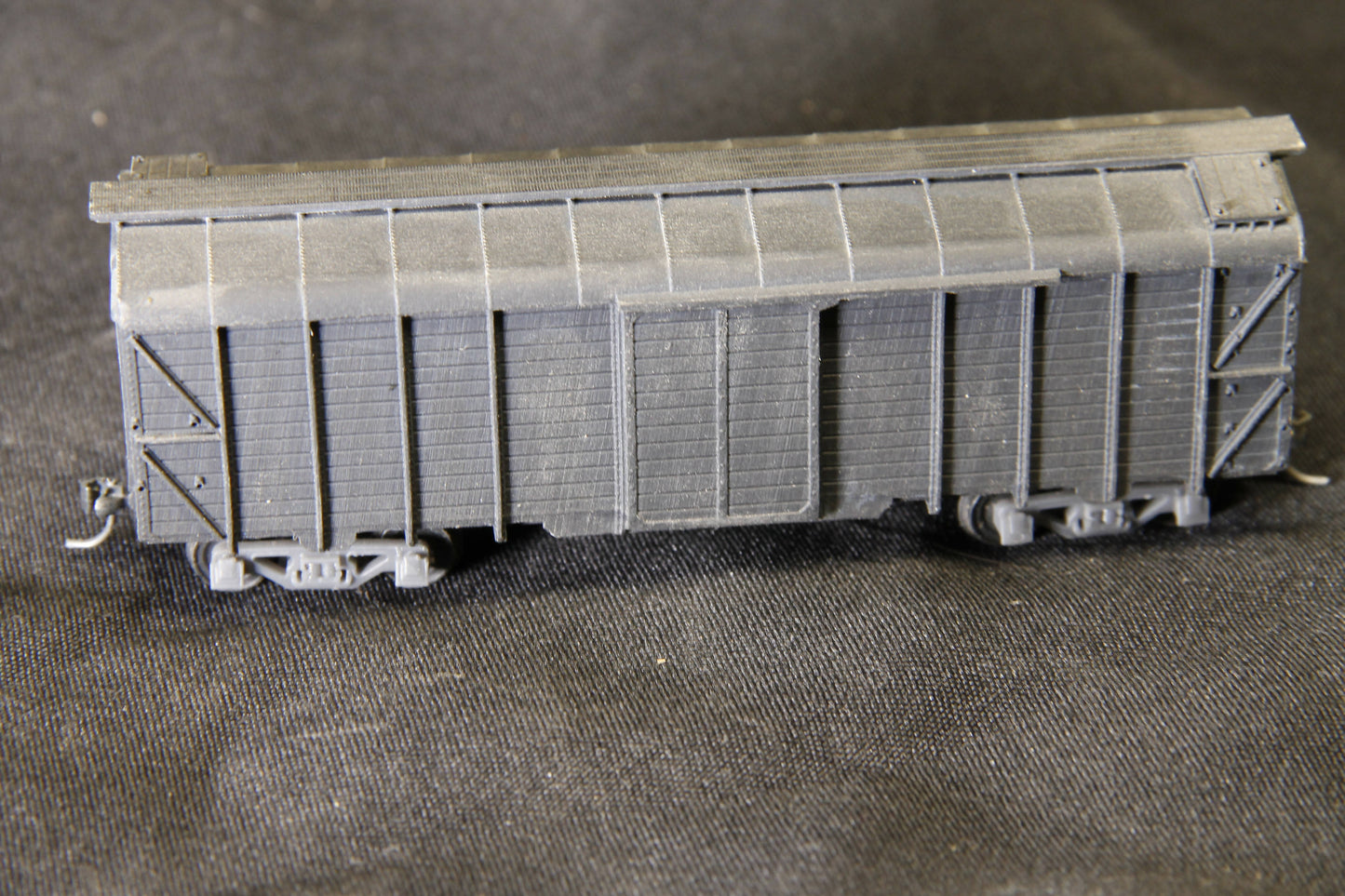
All in all an excellent model of a difficult subject, despite lacking the distinctive "Estado" pattern cast steel sideframe trucks. The KC brake cylinder/tank/triple is not acceptable, but easily replaced. I wholly commend the provision for wire grab irons.
But it's not a USRA Export Boxcar. While it is an export boxcar, the USRA was a WW-I institution that closed in 1920. These cars were built in the early 40's, initially for one of the South American meter gauge lines, when acquired by the USATC for Army use during WW-II. I am not sure if the order was condemned, of if production was continued as the quickest way to obtain modern narrow gauge boxcars suitable for world wide use. Possibly both. It is known that some saw service on the WP&Y, and on Oahu where a few survive.. I suspect that most served on North African or Indian meter gauge lines. Their wood sheathing was preserved using the Wolmanizing process, and for this reason a car is illustrated in one of the 1940's Car Builder's Cyclopedias, and reproduced in one of the Train Shed Cyclopedias.
In the late 1950s the White Pass made several purchases of these cars' underframes from Honolulu, and used them to build their 11xx container cars. An initial attempt with the bare frame was apparently not satisfactory, probably due to lack of side sills in the original stressed skin construction. Later conversions added steel channel side sills, initially 10" deep, a few 8", and 7" deep for most conversions. These initially ran with welded plate stake pockets and six sets of chains and binders to take three of WP&Y's 8' cube containers. Later these were removed and replaced with container cones at WP&Y's merchant box and ore bin spacing. I can provide photos if anyone wants to take on the project.
Made-to-Order Manufacturing
At 3DPT, every model is manufactured to order rather than pulled from warehouse inventory. This approach allows us to offer an extensive catalog while ensuring each piece is produced with the care and attention it deserves.
Most orders ship within 7-14 business days. However, larger models, complex projects, and high-volume orders may require 4-6 weeks or longer due to extended print times and production requirements.
While extended lead times are uncommon, they may occasionally occur during periods of high demand or due to circumstances outside our control. We appreciate your understanding as we continue our mission of preserving transportation history in miniature through high-quality, made-to-order models.